
The Complete Hardwood Flooring Guide for Charlotte Homeowners
Everything Charlotte and Mecklenburg County homeowners need to know about choosing, installing, and maintaining hardwood floors — species, costs, neighborhood project examples, and expert tips.

Charlotte is one of the fastest-growing cities in the Southeast, and its housing market reflects that energy. From the historic bungalows of Dilworth and Plaza Midwood to the new construction of Ballantyne and Steele Creek, Charlotte homeowners are investing in their properties at a pace that few other NC markets can match. And at the top of nearly every renovation wish list is the same upgrade: hardwood floors.
After 25 years and more than 10,000 floors installed across North Carolina — including hundreds of projects throughout Mecklenburg County — we've seen what works in Charlotte homes, what doesn't, and what the market rewards at resale. This guide puts all of it in one place.
Why Hardwood Flooring Is a Smart Investment in Charlotte's Market
Charlotte's real estate market is competitive and price-sensitive in the best possible way for homeowners who invest wisely. Buyers in neighborhoods like Myers Park, SouthPark, Ballantyne, and NoDa consistently rank hardwood floors among the top three features they look for — and they'll pay a premium to get them.
The numbers back this up. The National Association of Realtors reports that hardwood floors return 70–80% of their cost at resale on average, and in Charlotte's higher-demand neighborhoods, that figure climbs higher. A $12,000 hardwood floor installation in a Myers Park home can add $18,000–$22,000 in perceived value. That's not a renovation — that's an investment.
Beyond resale, Charlotte's climate makes hardwood a particularly smart choice. The city sits in a humid subtropical zone, which means hot, humid summers and mild winters. The right species and installation method, combined with proper humidity management, will give you floors that last 50 to 100 years without issue.
Charlotte's Housing Stock: What You're Working With
Understanding Charlotte's housing stock helps you make better flooring decisions. The city has three distinct eras of construction, each with its own subfloor characteristics:
Pre-1960 homes (Dilworth, Plaza Midwood, Elizabeth, Myers Park): These homes often have original pine or oak subfloors over a crawl space. They're excellent candidates for solid hardwood nail-down installation. Many already have original hardwood that can be refinished rather than replaced — a significant cost savings.
1960s–1990s homes (SouthPark, Ballantyne, Huntersville, Matthews): Typically built on concrete slab or with a plywood subfloor over a crawl space. Engineered hardwood is often the better choice here, particularly for slab-on-grade construction where moisture is a factor.
2000s–present (Steele Creek, Mint Hill, Cornelius, Davidson): New construction and recent builds typically have OSB subfloors. Both solid and engineered hardwood work well, depending on the specific subfloor condition and whether the home has a basement or slab foundation.
We assess every subfloor before recommending a product. The wrong product on the wrong subfloor is the number one cause of flooring failures — and it's entirely preventable.
Choosing the Right Wood Species for Your Charlotte Home
Species selection is the most personal decision in the process. Here's what we install most often in Charlotte and why:
White Oak — The Charlotte Standard
White Oak has become the dominant choice in Charlotte's renovation market over the past five years, driven largely by the influence of interior designers working in SouthPark and Myers Park. Its tight, consistent grain takes stain beautifully — from natural blond to deep charcoal — and its hardness (1360 Janka) handles the foot traffic of active Charlotte households.
Best for: Open-concept main floors, homes with dogs or children, any space where you want maximum design flexibility. Price range: $8–$14 per square foot installed.
Black Walnut — The Luxury Choice
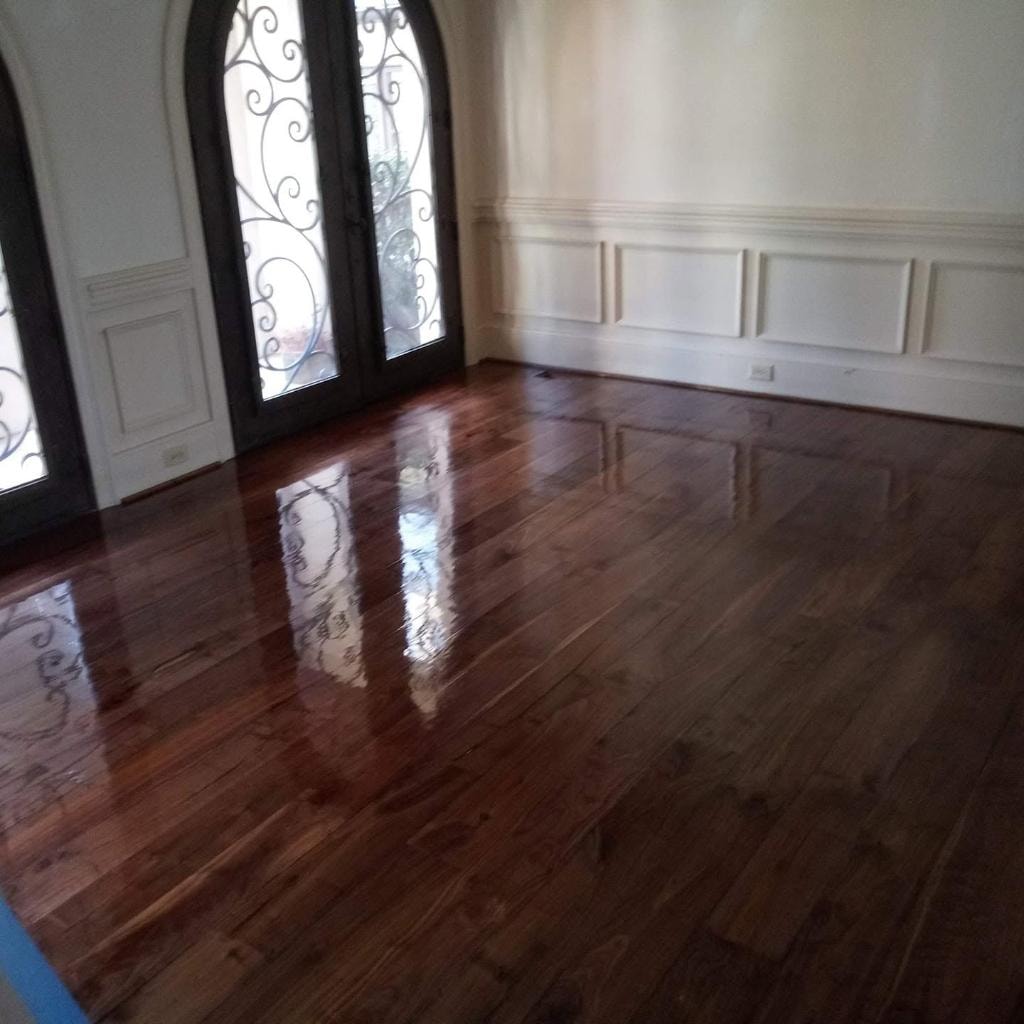
Nothing else in the domestic hardwood world matches Black Walnut's depth of color. Its rich chocolate tones with purple and red undertones are the defining feature of high-end renovations in Myers Park, Eastover, and the luxury new-construction market in Ballantyne. It's softer than Oak (1010 Janka), so it's best suited for lower-traffic areas.
Best for: Master suites, formal dining rooms, home offices, luxury renovations. Price range: $12–$19 per square foot installed.
Hard Maple — Clean and Modern
Hard Maple's near-white, uniform grain is the go-to choice for contemporary and Scandinavian-influenced interiors — a look that's increasingly popular in NoDa, South End, and the new-construction townhome market. It's also one of the hardest domestic species (1450 Janka), making it exceptionally durable.
Best for: Modern and minimalist homes, kitchens, high-traffic hallways. Price range: $7–$12 per square foot installed.
Red Oak — The Reliable Classic
Red Oak has been the backbone of American hardwood flooring for generations, and it remains a strong choice for Charlotte homeowners who want a traditional look at a reasonable price. Its open grain and warm golden tones work well in transitional and traditional interiors throughout the city's established neighborhoods.
Best for: Traditional and transitional homes, budget-conscious renovations, matching existing floors. Price range: $6–$10 per square foot installed.
Hickory — Bold and Indestructible
Hickory's dramatic color variation — from near-white sapwood to deep brown heartwood in the same plank — is polarizing by design. You either love it or you don't. But if you love it, there's nothing else like it. It's also the hardest domestic species available (1820 Janka), making it genuinely indestructible.
Best for: Rustic and farmhouse-style homes, lake houses, properties with heavy pet traffic. Price range: $8–$13 per square foot installed.
Engineered Hardwood — The Slab Solution
Charlotte has a significant percentage of slab-on-grade construction, particularly in the suburbs and new-construction neighborhoods. For these homes, engineered hardwood — a real wood veneer over a dimensionally stable plywood core — is often the right answer. It handles moisture better than solid hardwood, can be installed directly over concrete, and is available in every species and finish option.
Best for: Slab foundations, basements, homes with radiant heat, any application where moisture is a concern. Price range: $7–$15 per square foot installed, depending on species and veneer thickness.
What Does Hardwood Flooring Cost in Charlotte?
Charlotte's labor market is competitive, and flooring costs reflect that. Here's a realistic breakdown based on current Mecklenburg County project pricing:
Material costs (per square foot):
- Budget-friendly species (Red Oak, standard Maple): $3–$5
- Mid-range species (White Oak, Ash, Hickory): $5–$9
- Premium species (Walnut, Brazilian Cherry, wide-plank): $9–$16+
Installation labor (per square foot):
- Standard nail-down or glue-down: $3–$5
- Floating installation: $3–$4
- Complex patterns (herringbone, chevron, parquet): $7–$12+
Additional costs to budget for:
- Subfloor assessment and repair: $1–$4 per sq ft (slab leveling can run higher)
- Removal of existing flooring: $1–$2 per sq ft
- Site-sanding and finishing (unfinished wood): $2–$4 per sq ft
- Moisture barrier (required over concrete): $0.50–$1.50 per sq ft
- Baseboards, transitions, and stair nosings: $300–$800 depending on scope
Typical total project costs in Charlotte:
- 600 sq ft living/dining area (White Oak, pre-finished): $5,500–$9,000
- 1,200 sq ft main floor (White Oak, site-finished): $12,000–$19,000
- 2,500 sq ft whole-home renovation (mixed species): $22,000–$38,000+
These are real numbers from real Charlotte projects. Every home is different — subfloor condition, layout complexity, and finish choices all affect the final price. We provide free in-home estimates so you know exactly what your project will cost before any work begins.
Before and After: Real Mecklenburg County Projects
The transformation that hardwood floors deliver is best understood through real projects. Here are three recent examples from across Mecklenburg County:
Project 1 — Dilworth, Charlotte A 1940s Dilworth bungalow with original pine floors that had been covered by carpet for decades. Rather than replacement, we uncovered and refinished the original floors — sanding through 80 years of finish, repairing damaged boards, and applying a fresh satin oil-based finish. The result was floors with genuine character that no new installation can replicate. Total cost: $4,200 for 900 square feet. The homeowners received three offers above asking price within a week of listing.
Project 2 — Ballantyne, Charlotte A 2008 slab-on-grade home in Ballantyne where the original builder-grade carpet had reached the end of its life. The owners chose 5-inch engineered White Oak with a custom gray stain to complement their updated kitchen. We installed a moisture barrier over the concrete, glued down the engineered planks, and finished with new baseboards throughout. Total cost: $16,800 for 1,600 square feet. The home appraised $24,000 higher than the pre-renovation estimate.
Project 3 — Huntersville A new construction home in Huntersville where the builder's standard flooring package was upgraded before move-in. The owners chose 4-inch solid Red Oak with a warm medium-brown stain for the main level and 3-inch Hard Maple for the upstairs hallway and bedrooms. Total cost: $19,400 for 2,100 square feet. The upgrade was completed in six days, before the owners moved in.
Charlotte's Humidity: The Factor Most Homeowners Overlook
Charlotte's climate is the single most important variable in hardwood floor longevity, and it's the one most homeowners underestimate. The city averages 70–80% relative humidity in summer and drops to 30–40% in winter. That 40-point seasonal swing causes wood to expand and contract — and if your floors aren't installed and maintained correctly, that movement shows up as gaps, cupping, or buckling.
Here's how to manage it:
During installation: Proper acclimation is non-negotiable. We deliver the wood and let it sit in your home for 5–7 days before installation, allowing it to reach equilibrium with your home's specific temperature and humidity. Skipping this step is the number one cause of floor failures in Charlotte.
Year-round maintenance: Keep indoor relative humidity between 35–55%. In Charlotte's humid summers, your air conditioning does most of this work. In drier winters, a whole-home humidifier or room humidifiers in key areas prevent gaps and cracking.
Subfloor moisture: For slab-on-grade homes, we test concrete moisture levels before installation. Concrete that tests above 3 lbs per 1,000 sq ft per 24 hours (MVER) requires a moisture barrier. We never skip this test — moisture problems discovered after installation are expensive to fix.
The Installation Process: What to Expect
Here's what happens from the day you sign a contract to the day you move your furniture back in:
Day 1–7 (before installation begins): Wood delivery and acclimation. The flooring sits in your home, adjusting to your environment.
Installation day 1: Subfloor preparation — cleaning, leveling, moisture testing, and any necessary repairs. Layout planning and reference line establishment.
Installation days 1–3: Board installation. A standard 1,200 sq ft main floor takes 2–3 days for a two-person crew.
Days 4–6 (for site-finished floors): Sanding in multiple passes, stain application (if desired), and two to three coats of finish with light sanding between coats.
Final day: Transitions, baseboards, final inspection, and walk-through with you.
Total timeline: 5–8 days for a standard main-floor installation with site finishing. Pre-finished floors are faster — typically 3–4 days.
Hardwood Floor Maintenance for Charlotte Homes
The right maintenance routine protects your investment for decades:
Daily:
- Sweep or dust-mop to remove grit (the primary cause of surface scratches)
- Clean spills immediately — standing water damages the finish and can penetrate to the wood
- Use felt pads under all furniture legs
Weekly:
- Damp-mop with a hardwood-specific cleaner (Bona, Bona Hardwood, or Method Wood Floor)
- Never use steam mops, wet mops, Murphy's Oil Soap, or vinegar — all damage the finish over time
Seasonal:
- Monitor humidity and adjust your HVAC or humidifier as Charlotte's seasons change
- Check for gaps or cupping after the first winter — minor movement is normal; significant changes warrant a call
Long-term:
- Screen and recoat the finish every 5–7 years to restore sheen and protection without a full sand
- Full sand-and-refinish every 20–30 years (solid hardwood can be refinished 5–10 times over its life)
EPA Lead Paint Certification: Critical for Charlotte's Older Neighborhoods
If your Charlotte home was built before 1978 — which includes virtually all of Dilworth, Plaza Midwood, Elizabeth, Myers Park, Eastover, and NoDa — federal law requires any contractor performing renovation work to be EPA Lead-Safe Certified.
American Home Renovation is EPA Lead Paint Certified. We follow all required containment, work practice, and cleanup procedures to protect your family during any renovation work in pre-1978 homes. When you hire a flooring or renovation contractor for an older Charlotte home, always ask for their EPA certification. It's the law, and it's your family's safety.
Frequently Asked Questions
Can you match my existing hardwood floors in my older Charlotte home? Often yes. For homes in Dilworth, Myers Park, and other historic neighborhoods, we carry a wide range of species, widths, and stain colors. For original pine or oak floors, we can custom-blend stain to match. We bring samples to your home before committing to any color.
My Charlotte home is on a slab. Can I still get hardwood floors? Absolutely. Engineered hardwood is specifically designed for slab applications and is available in every species and finish option. We test concrete moisture levels before installation and install a moisture barrier when needed. Many of our best Charlotte projects are in slab-on-grade homes.
How long does a Charlotte flooring project take? For a standard main-floor installation (1,000–1,500 sq ft), plan for 5–8 days total including acclimation. Pre-finished floors are faster. We'll give you a specific timeline during your free estimate.
What's the best hardwood floor for a Charlotte home with dogs? Hard Maple (1450 Janka) or Hickory (1820 Janka) are your most durable options. White Oak (1360 Janka) is also excellent and offers more finish flexibility. We recommend a matte or satin finish — it hides scratches better than high-gloss.
Do you serve the suburbs — Huntersville, Matthews, Mint Hill, Cornelius? Yes. We serve all of Mecklenburg County and surrounding areas. Call (336) 587-5371 to schedule a free in-home estimate anywhere in the Charlotte metro.
Ready to Get Started in Charlotte?
American Home Renovation has been installing hardwood floors across North Carolina for 25 years and more than 10,000 projects. We serve Charlotte and all of Mecklenburg County — from Dilworth and Myers Park to Ballantyne, Huntersville, Matthews, Mint Hill, Cornelius, and Davidson.
Every project starts with a free in-home estimate. We'll measure your space, assess your subfloor, walk you through species and finish options, and give you a detailed written quote with no obligation.
Call us at (336) 587-5371 or request a free estimate online. We're ready to help you get the floors your Charlotte home deserves.
Explore Topics
Written by
American Home Renovation
Content creator and writer sharing insights and stories.
